10 Interactive Video Art Projects that Get Physical with Screens

Monday, February 8th, 2010

People have always loved watching screens. The video screen has surged where people love this window onto a whole new world of possibility and opportunity. We are increasingly feeling this attraction with screens. Over the past decade we have seen the emergence of more and more screens with serious multimedia capabilities. Today, we use screens for informing, communicating, entertaining, and connecting. The following are ten of my favorite interactive video art projects that I believe make strong emotional connections with people using screens.

1. Potent Objects
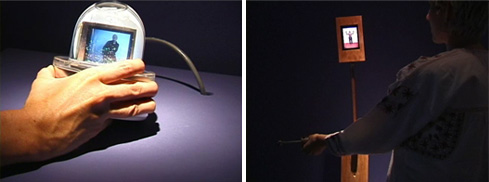
Potent Objects playfully examines the way we ascribe emotion to inanimate technologies. The work parallels current research in ‘affective computing,’ in which the capability of sensing and conveying emotion is built into computing devices. (Work by Camille Utterback)
Read more »

Rusty Business Documentation

Monday, December 21st, 2009

Presented at the ITP Winter Show 2009 and NIME 2009, Rusty Business is a video sequencer that produces electronically controlled cartoon antics using large inflatable hammers.

0_DSCN2350 0_DSCN2458 0_DSCN2397 0_DSCN2430 0_DSCN2345 0_DSCN2390 0_DSCN2318 0_DSCN2433 0_DSCN2432 0_DSCN2381 0_DSCN2431 0_DSCN2389 0_DSCN2404 0_rusty_and_kids 0_DSCN2351 0_DSCN2436 0_DSCN2394 0_DSCN2403

A database of slapstick comedy gags are executed when inflatable hammers hit push button switches. The interactions performed by the users handling of the hammer produces a unique visual and auditory experience onto the projected montage displays. Every hit from the inflatable hammer triggers a different, unexpected and shocking reaction from the character, conveying his struggles with work, sickness and modern day insanities.

Read more »

The Joy of Technology

Tuesday, December 23rd, 2008

The Joy of Technology is a playful video installation that uses both humor and drama to emphasize our intimate relationship with technology. The satirical character inside the cardboard television set responds to the user’s operation of technology. An electronic razor grows hairs on his face, a pencil sharpener rotates him and tears his shirt, a stapler pokes staples onto his forehead and leaves shatters all over the television glass, and a blow-dryer rotates the screen. All these actions affect the character’s overall appearance once all the technologies are shut off. In addition, the character can also be placed into different settings by turning the television’s rotating knob. Some of the programming that the character is placed into includes a news broadcast, a courtroom and outdoor settings.

Jason Safir giving a live demonstration of his interactive television at ITP.

The main character always appears lost and has lost control of himself through the technology around him. Watching the main character being trapped in an endless, repetitive loop makes his pointless actions and gestures hopeless and neurotic. The piece projects humor and irony throughout the user’s experience by implementing opposite feedback from common technology we use everyday.

FUTURE DEVELOPMENTS
- A robotic television that vibrates and rotates. Also, an antenna that moves when there is activity inside the screen.
- Development of character and channels: more channels that individually respond differently to each device. More dynamic animations.
- Randomized effects implemented by each technology rather having them all pre-determined and edited.
- A more polished cardboard box television design and more interesting placement of props.
- Ability to adjust the depth of field (blurring) of the screen when increasing and decreasing the intensity of a dimming lamp.
- More technology!


Sharpening character

Staples and shatters

When the screen is rotated upside down with the blow dryer, nails fall down!


Electric razor static


Orlando’s courtroom

TECHNICAL DETAILS
The installation uses serial communication between Arduino and Flash using the as3Glue library. To make each device trigger an animation, I used Phidgets current sensors to detect how much voltage is coming from each device. Conditions were placed with these values to change the character’s overall appearance once these devices were shut off. Other physical computing components used were a potentiometer, LEDs, miniature vibration motors placed inside the box, a subwoofer, speakers and a flat screen monitor.


Phidget current sensors detecting the voltage from the razor, sharpener and blow dryer.

All animations were recorded in real-time behind a green screen and then were traced with a fine liner pen using a light box. These selected stills were then scanned and converted into vector graphics using Illustrator and then colored in Flash. This lengthy process helped me achieve the vibrancy and quality I was looking for in both the character and the environments that he is placed into.


All animation frames were drawn using a fineliner marker and were then vectorized into Flash.

Modern Living

Saturday, November 29th, 2008

click here to watch the video in a higher resolution

Modern Living is a series of fifteen television parodies that mock various perspectives of television culture. The five-minute compilation pokes fun at our TV-addicted age by presenting a variety of imitated television programming and advertisements. These segments center around issues and themes that is relevant in our modern times including mass-consumption, obsession with stardom and ubiquitous technology. Each parody is presented with the same recognizable character throughout, who is placed in different mediated contexts. The performer also acts as the viewer of his own programming, revealing a perspective of television we don’t see when sitting on our couch.

Modern Living advances on my continuous interest in mocking television culture. These parodies are meaningful to me because they reveal the deceptiveness behind media corporations in a fun and creative way. The work also illustrates the damaging effects television can place on a viewer’s impression of the world.

Final Project Update!

Friday, November 21st, 2008

Production for my final project in my physical computing class is going very well and I am beginning to feel excited about it. My concept has changed a great deal since I sketched it out two weeks ago. This evening, I received all the electronic components that I will require for my project in the mail. I just went through some successful tests with the AC current sensors that I will be using for my video installation. It was interesting to see the different feedback I was getting from the different electronic devices that I am considering using. I am looking forward to playing with these values and then develop some dynamic output effects with them. I am also considering implementing homemade devices with some of the sensors that have been introduced to us in the beginning of semester such as photo cells and flex sensors.

Now that I have resolved all the issues surrounding the input aspect of my piece, tomorrow I plan to begin developing the output phase of my project. I have decided that the video projection that I will be using will be all in vector graphics which means I have a lot of drawing to do! The main character I am using is very eccentric and awkward which will add a lot of humor to the piece. I plan to record voices for the cartoon character as well.

That is all I really want to say about my progress for my final project for now. I would like to keep much of what I am planning as a surprise for my final presentation!

Boiling Particles

Monday, November 3rd, 2008

There are many meaningful ways to project interactive particles than on a flat surface screen. Many web art sites depict intricate and well-designed algorithms, but I feel there are more appropriate contexts to present these animations. A futuristic antique could add a whole new dimension to algorithm animations.

Boiling Particles is a virtual cooking pot. The knobs positioned on the stove top adjust the patterns and behaviors of the digital particles that are virtually boiling inside the pot. When the temperature of the water is adjusted with the knobs, the intensity and color scheme of the particles in the animation slowly respond and changes with a randomized effect. The inclusion of accentuated boiling sounds may also be implemented into this new media device.

TECHNOLOGIES
- projector positioned underneath pot
- laptop for serial communication with Arduino and Flash
- Particles application developed in AS3
- Wooden stove top with knobs connected to Arduino micro-controller
- Stove pot with hole underneath
- A sheet of transparency paper to cover the pot’s empty base
The production process has three stages:
1) Programming the particles algorithm
2) Building wooden stove-top prototype with three knobs/potentiometers
3) Hardware and projector setup

HAVE A TASTE
Boiling water is fun … but I am an amateur when it comes to cooking. A virtual cooking device is what I need to learn how to better manage myself in the kitchen. If I screw up, there are no consequences and no food wasted. By projecting boiling water through a digital projection, the process of cooking can be more magical, colorful and visually intriguing. My idea is a scary one too. The way our digital age is progressing, we are losing our conception of reality. Computers are increasingly framing our notion of realism. There is an infinite amount of ways to improve all aspects of our lives with technologies – many of which reduce our ability to understand the reality we live in today. This scary transition, that the digital age is encouraging, is what I seek to express in my futurist antique.

Light Sculpture

Monday, September 15th, 2008

For this week’s assignment my challenge was to use candles to convey a message. I first thought it would be interesting to compose the candles in letters that would reflect a word involving light, in this case “Lit”.

For my light sculpture, I chose to center an object around candles. I arranged the candles into a male symbol and placed a black formal shoe at the center. The shoe is iconic for materiality. Also, the shoe is glossy and is thus reflective from the light. The color black was the perfect choice.

Similar to the figure above, in this example I arranged a candles into a women’s symbol and depicted a high heel as the main subject. I feel this juxtaposition between the two example convey a strong message about the objectives of capitalism cultural hegemony. The use of candles and light projects made this interesting concept possible.

Response to the Futurist’s Manifesto: “Technical Manifesto of Futurist Painting”

Monday, September 15th, 2008

The objectives of new media differ considerably than to the ideas expressed in the Futurist’s manifesto “Technical Manifesto of Futurist Painting”. While both of their perspectives share a desire to modernize art by adapting it to the changing world, the Futurist’s greatly opposed two things that new media now embraces: the use of technology in art and the notion of mechanical reproduction. Coming from a new media background, the Futurist’s outlined declarations stated in their manifesto feels harsh and stubborn; however, I feel a great deal of respect for what they stood for at the same time.

A painting is more than just its subject. The Futurists believed that every detail in a painting has an effect on the context of the overall picture. The Futurist’s ultimate argument was that pictures are absolute: they have the spiritual power to give off a dynamic sensation onto its viewer if they are interpreted in intellectually. Coming back to today, this argument is very relevant in how we interpret multimedia experiences. Many details and aspects are usually ignored by the viewer, yet they play a great significance in the output of their experiences. The Futurist’s declared that innate complementariness is an absolute necessity in painting. Our psyche has a habit of blocking things out, yet elements that are ignored sub-consciously affect how we see things. If we make a conscious effort to become familiar with the inter-disciplinary elements involved in all art forms, our eyes will become trained to see more. I believe that an application of the Futurist’s approach of dynamism would help us become more engaged to art pieces, enhancing our overall experiences to them in a new light.

Any artist working in new media has to oppose many of the ideas aggressively expressed by the Futurists. However, it is important to recognize that their ideas have had an immense impact in the way we understand and produce art today, in other words, postmodernism.

Response to Zdenek Pesanek Reading

Saturday, September 13th, 2008

Kinetic light sculpture is an under-appreciated art form that serves a valuable purpose in the technological ubiquitous world we live in today. When it turns dark, and when most metropolises practically become light sculptures themselves, tall buildings become illuminated with an immense amount of lights that can be identified from miles away. There is a clear appreciation and admiration for city lights, so why not for kinetic light sculptures?

Zdenek Pesanek, a kinetic light artist born in Czech Slovakia, saw the distinct beauty and illuminating qualities that light sculpture can breed into new and relevant ideas. He saw light to be as expressive as paint, using colored bulbs as an architectural spatial form. In his ‘Kinetic Light Piano’, developed in the early twentieth century, multi-colored lamps were activated by keyboard keys. The underlying idea here was to express the twelve tones of the music scale in color. Falling into similar paths to those of Vannevar Bush and Roland Barthes, Pesanek’s kinetic creations and ideas were faced with more criticism than admiration, but today, are widely respected. I believe the reason for this is a fear of change. This fear is characterized by other traditional art forms being replaced and lost by the technological revolution. Another reason is reflective to that of a modernist perspective that dictates a one-dimensional point of view that does not favor adaptability to changing ideas. Many kinetic light artists today have a difficult time projecting their work in public areas because they are deemed as distracting. That statement seems hypocritical when luminous commercial ads, which beg for your attention when you pass them by, have no problems making their way into city streets. The present art culture is breathing in a postmodern era that is still at a far distance from reaching its ultimate objectives. Instead, video sculpture is perceived as something that falls into anarchy.